| C O A T O F A R M S Motto: Ne in nobis interiora obscura spectes — tamen ex caelo orti sumus. |
 T H E H O U S E O F K I R N E V |
The Kirnevs were renowned as brave warriors and skilled horsemen. They lived in the Balkans and were free knights (boilas), never swearing allegiance to any suzerain, as they deeply valued their independence.
For millennia, Kirnev family members were Maenads and Bacchants of the Dionysian religion, known for its ecstatic rituals, many of whose traditions Kirnevs continue to honor and practice to this day. The sacred rites and arts of winemaking were passed down from one generation to the next, and even in the XXI century, Zahar Kirnev and Jurii Kirnev continue to produce wine according to their ancestors’ recipes, calling it, as in old times, Raven’s Blood.
The coat of arms depicts a noble and wise black raven set upon a golden shield — a symbol of wisdom and strength. The image of the black raven has formed part of the family tradition for millenia, and it became the official heraldic emblem of the Kirnev family in the XV century, when members of the family joined the Black Army during the wars against the Ottoman Empire.
 T H E H O U S E O F T U C A N |
The family legend describes the Tucans as a clan of secretive, almost mystical alchemists. In addition to precious metals, they traded in magical objects, potions, and ancient scrolls. Beneath the basements of their trading houses lay a network of hidden chantries and alchemical workshops. These spaces were described as safe havens for dissident minds persecuted by the religious authorities of the Ottoman Empire, where free thinkers could preserve and share their traditions.
The house possessed no formal coat of arms; instead, it bore a longstanding emblem depicting a white (or silver) tree with strong roots and a broad crown. The image symbolised deep family roots, health and fertility, as well as familial bonds and prosperity. According to tradition, a tree with a white trunk was planted before every family residence. To this day, a white tree stands before the Kirnev family château as well.
 T H E H O U S E O F Z A H A R I A |
There is one amusing episode involving a relative of the Zaharia family that illustrates the passionate and fiery temperament of the clan. Lekë Zaharia, son of Koja Zaharia, was invited on 26 January 1445 to the wedding of Karl Muzaka Thopia, Lord of Berat, to Princess Mamica Kastrioti — the sister of the Albanian hero Skanderbeg. At the feast, Lekë Zaharia met Jerina Dushmani, Princess of Zadrima and Pult, and began courting her so successfully that by the end of the evening she had, for all practical purposes, become his wife (though the marriage was not yet formally concluded). However, she had long been pursued by another nobleman, Lekë III Dukagjini. When he learned that the lady had chosen Zaharia over him, he challenged Lekë Zaharia to a duel. Interestingly, 105 people died in that "duel" — yet neither of the two initiators was among the dead. Lekë Zaharia emerged victorious in fair combat and generously spared Dukagjini’s life. Dukagjini, however, could not accept his defeat. A couple of years later, he ordered his brother, Nicholas Dukagjini, to treacherously murder Lekë Zaharia.
Since inheritance rights were passed only through the male line, and Lekë Zaharia was the last of that line, the castle of Dagnum was taken by Skanderbeg, and it is considered that the glory of the Zaharia family began to decline. However, female descendants, through marriage, continued to preserve the noble name and traditions, which have survived to this day. This was often reflected in their high level of education, strong-willed nature, and passionate character.
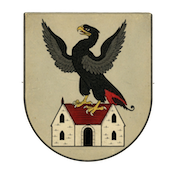
The coat of arms is described as a black eagle with a red tail, holding an architectural element (a house, fortress, or church) in its claws — symbolizing the historical act of seizing power into their own hands.
 T H E H O U S E O F R A I C U |
Radu IV the Great became renowned as a wise ruler, a cultural reformer, and a patron of education. Among his achievements, he introduced the printing press to Wallachia. He was a direct descendant of Basarab I the Founder and a nephew of the famous Vlad III the Impaler, known in folklore as Dracula.
This lineage has always taken pride in its education and in preserving ancient family traditions.
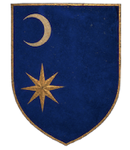
The coat of arms is described as a silver crescent moon and a golden star (sometimes a sun) on a blue shield. This image symbolizes the duality and completeness of the world through the balance of day and night. Historically, additional elements were often included, such as a black raven, an eagle, or an aurochs; sometimes a cross or other details, frequently changing due to political and religious shifts. For this reason, the Raicu family preserved their coat of arms in its pure form.
 T H E H O U S E O F S A F A R I A N / A V E T I S I A N |
In the XIX century, the Safarians owned many bakeries and were considered a noble house in Armenia. By the early XX century, due to political repression, members of the family were forced to change their surname and destroy all evidence of their noble origins and connections to the old name. As a result, it is unfortunately impossible to trace this part of the genealogy beyond the first officially recorded Avetisian in the family, Hakob Avetisian.
The new surname was chosen in honor of a respected and wise member of the family — Avetis Safarian. This name, in Armenian (Ավետիս), means “good news” or “blessing.” One might assume that he was the father of Hakob Avetisian, since Avetisian translates as “descendant of Avetis”; however, according to the accounts of Raphael Avetisian, this was not the case. All ties to the past were deliberately severed so that the family’s origins could no longer be traced.
The family has no single official emblem, as heraldry was not widely practiced in Armenia, and even if such a symbol had existed, it would most likely have been erased from history. However, two informal symbols were associated with the Safarian and Avetisian families.
The first was the fruit of the pomegranate. It was never used as a formal heraldic image, but rather as an element of household decoration. Two or three pomegranates placed together (sometimes depicted in gold) symbolized a strong family union, eternity, and rebirth — particularly meaningful in light of the Avetisian family’s own renewal.
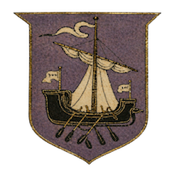
The second symbol was a ship, or individual nautical elements such as a helm or an anchor, reflecting the family’s connection to travel and seafaring.
 T H E H O U S E O F M U R A W I E W |
According to legend, the family is even older and descends from Ratsha in the XII century, the progenitor of several ancient noble lineages: the Murawiews, the Buturlins, the Pushkins, and many others.
The Murawiew family is one of the most titled noble houses of the Russian Empire. Among its members were both high-ranking statesmen and military generals who strengthened imperial power, as well as prominent revolutionaries and Decembrists who fought against that very same empire. This lineage was so large and influential that, as they would jokingly say, the entire history of Russia was the history of internal conflicts within a single family.
During the Russian Revolution, the Murawiews did not hide their noble origin, as the lineage was too prominent and directly traceable, which led to harsh repression. Nevertheless, the Murawiews ultimately carried their traditions, education, and nobility with pride into the present day.
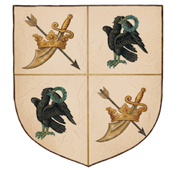
The coat of arms is described as a shield divided into four quarters. In the first and fourth quarters, a sword and an arrow are depicted beneath a golden crown; in the second and third quarters, a black eagle holding a wreath in its beak. These are symbols of military valor and noble dignity. The Murawiew coat of arms does not have a single fixed form — different branches of the family show slight variations.
 T H E H O U S E O F G L A Z U N O V |
Through their printing and publishing activity, the Glazunovs made a significant contribution to the development and dissemination of culture in the Russian Empire. Thanks to their publishing house, Russian literature gained international recognition. They also contributed to education by producing scientific works and school textbooks in large editions.
In the XXI century, members of the family continue to engage in publishing, following their long-standing traditions.
The Glazunov family also included many creative individuals, who mostly expressed themselves through music. Nearly all members of the family could play musical instruments or sing well. Their patrons were the pale muses Erato and Euterpe.
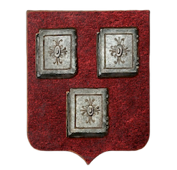
The coat of arms is described as three silver books on a red shield. Motto: LABOR UTILIS.